The Moon in daylight
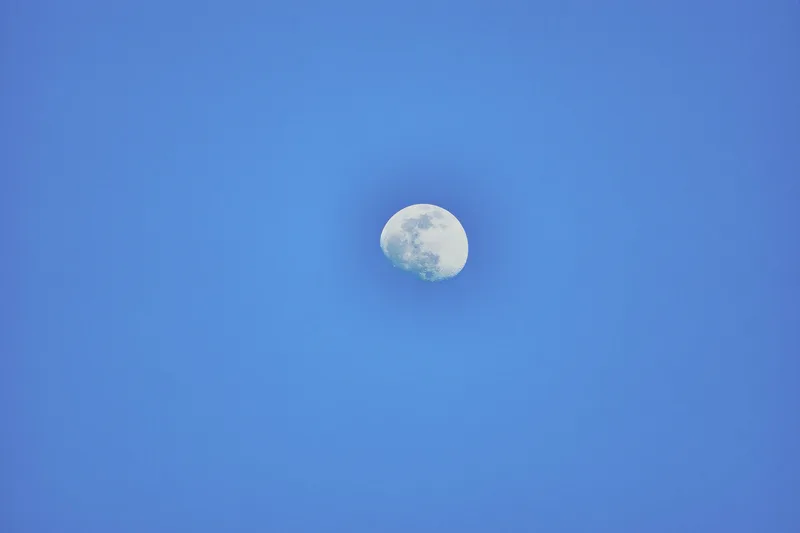
Yes, that’s the Moon.
You can see the Moon during the day because it reflects sunlight, and it spends part of most days above your horizon. It doesn’t wait for the sky to get dark.
The easiest place to start: look for a half Moon on a clear afternoon, or on a clear morning.
TRY THIS NEXT TIME YOU’RE OUTSIDE
Pick a phase. Find your window.
The phase gives you a rough time of day to look. These are broad patterns, not a forecast for your location. Clouds, the horizon and the Moon’s height still matter.
First quarter: try the afternoon.
A time guide, not a map of the skyA first quarter Moon rises around noon and sets around midnight. Look in the afternoon, when it is well away from the Sun in the sky.
Shapes use a northern-hemisphere illustration. Orientation changes with your location and the time; the morning/evening pattern does not reverse in the southern hemisphere.
Daylight doesn’t switch the Moon off.
Moonlight is sunlight reflected from the lunar surface. That happens in daylight too. When the Moon is above your horizon and bright enough to stand out against the blue sky, you can see it.
Its orbit changes where it sits relative to the Sun. Near first quarter it is in the afternoon sky. Near last quarter it is in the morning sky. That is why you can walk outside for coffee and find a half Moon still there.
A blue sky makes it harder to spot, not impossible. Try a clear day and give your eyes a moment. A pale white patch can become a surprisingly crisp Moon once you notice it.
Two good chances to catch it
Before full Moon: afternoon
Around first quarter, the Moon rises near noon. In the following days, the growing, gibbous Moon rises later. Try the late afternoon before sunset.
Find the next first quarter · See the waxing gibbous guide
After full Moon: morning
The waning Moon stays up after sunrise. Around last quarter it rises near midnight and sets near noon, making the morning a good time to look. In the following days, the waning crescent grows thinner and is easiest to spot before sunrise.
Find the next last quarter · See the waning gibbous guide
Use your eyes to look well away from the Sun. Never point binoculars or a telescope toward the Sun to search for the Moon.
A few things you might wonder
Does a daytime Moon mean something unusual?
No. It is a normal part of the Moon’s orbit. You may notice it more on a clear day, or when you happen to be outside at the right time.
Why can’t I see it every day?
It may be below your horizon, behind clouds or buildings, too low in the sky, or too close to the Sun’s direction to stand out. Seeing a Moon in a phase guide doesn’t guarantee it is visible where you are.
Can I see a full Moon during the day?
Look near sunrise or sunset. Around full Moon, it is opposite the Sun in the sky, so it is mainly above the horizon at night. A nearly full Moon can linger after sunrise or appear before sunset.
What about a new Moon?
At new Moon, its sunlit side faces away from us and it is close to the Sun in our sky. It is not an ordinary visible daytime Moon. During a solar eclipse its silhouette can cross the Sun, but that requires proper solar-viewing protection.
Which one was yours?
The Moon you spot today might be a different shape from the one on your birthday. Enter your full date of birth to find that phase.
Find my birthday MoonKeep looking up
Learn to tell waxing from waning · What a Blue Moon actually means
Astronomy references: NASA’s Moon phase guide and NASA’s observing guide. The illustrations are teaching aids, not live sky charts.