Moon phase
The first quarter Moon
The first quarter Moon is a half-lit Moon that is waxing, or growing toward full. It is about a quarter of the way through the cycle from one new Moon to the next. Look for it in the afternoon or evening, about a week after new Moon.
Next first quarter
17 December 2026 at 00:43 EST
50% lit · Waxing · Evening sky
When is the next first quarter Moon?
Next first quarter: 17 December 2026 at 05:43 UTC, 17 December 2026 at 00:43 EST US Eastern.
The one after: 15 January 2027 at 20:35 UTC.
Computed 22 November 2026 UTC.
First quarter is an instant, when the Moon is 90 degrees east of the Sun in its phase cycle. The half Moon you see that evening and the evening either side all look about the same.
The first quarter Moon rises around noon, is generally high in the sky around sunset, and sets around midnight. It is a good evening Moon: up early, bright enough to see by, and showing sharp crater shadows along its straight edge.
Why is a half Moon called a quarter Moon?
It is called a quarter Moon because it is about a quarter of the way through the cycle from new Moon to new Moon. Half describes the bright disc we see; quarter describes its place in the cycle.
The Sun still lights roughly half of the whole Moon. From Earth, at this angle, we see half of that sunlit hemisphere and half of the night side. The dark half is the Moon’s own night side, not Earth’s shadow. Earth’s shadow falls on the Moon during a lunar eclipse.
The cycle runs from new Moon back to new Moon. These are schematic views, not an orbit map or a local sky forecast.
“Half Moon” tells you the shape. “First quarter” tells you which half Moon it is: the one growing toward full. The last quarter Moon is the other half Moon, shrinking toward new.
First quarter or last quarter?
Both are half Moons. The difference is when you see them and which side is lit. Compare the last quarter Moon, or learn why a half Moon is visible during the day.
- First quarter is in the evening sky. It is highest around sunset and sets around midnight. In the northern hemisphere the right half is lit.
- Last quarter is in the morning sky. It rises around midnight and is highest around sunrise. In the northern hemisphere the left half is lit.
In the southern hemisphere, swap the sides in these diagrams. The angle you see also depends on your latitude and the time of day, especially near the equator. “Right” or “left” alone is not a reliable way to identify a Moon in a photograph.
Why it looks like this
At first quarter the directions from Earth to the Sun and Moon make a right angle, so we see half of the Moon's sunlit side. The line between light and dark runs straight down the middle. In our birthday calculator a phase angle from 80 to 100 degrees counts as first quarter, which is a band about a day and a half wide.
Look along the edge between day and night
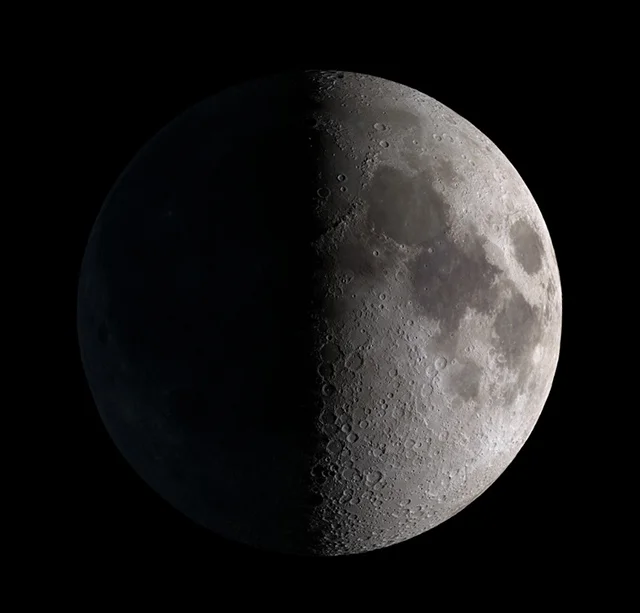
That light-dark boundary is called the terminator. The Sun is low over the ground there, so crater rims and mountains cast long shadows. The face can look much less flat than it does at full Moon.
- Start in the late afternoon. A first quarter Moon can be visible before sunset. Use your eyes first; never point binoculars or a telescope toward the Sun.
- Look again as the sky darkens. It is generally high around sunset and sets around midnight. Those are rough guide times, not a forecast for your address.
- Try binoculars after sunset. Steady them against a support and explore the boundary. You may pick out dark, smoother plains beside brighter, rougher cratered ground.
In a northern-hemisphere diagram, the right half is lit. In the southern hemisphere, the view is reversed. In your actual sky, the angle turns with your location and the time: do not identify the phase from a tilted photograph alone.
Why you can see the Moon in daylight · Try the phase scrubber
Sources: NASA: Moon phases and NASA: observing the Moon.
Look for it in daylight
First quarter is a good afternoon Moon to look for, well away from the Sun. Use the phase guide to choose a morning or afternoon viewing window.
Born under a first quarter Moon
Was this the Moon on the day you were born? A birthday can fall under any of the eight phases. Enter your full date below to check, or find your birthday Moon to see its shape and how much was lit.
If your result is first quarter, our playful name for it is The Builder: “Pressure makes you decisive.” It is a character we wrote for this site, not a personality diagnosis or an astronomical finding.
Use the year you were born. The Moon on the same calendar date usually changes from one year to the next.
Were you born under a first quarter Moon?
FOR FUN AND REFLECTION
Your Builder reading
You were born at the first turning point of the cycle, when the Moon is exactly half lit and half dark. It's a moment of tension in the sky: the new Moon's plans meet the real world, and something has to give. You were made for that moment.
Continue to your Moon readingThe Moon's phase at birth has no proven effect on personality.
What traditions say it means
“First quarter” has a precise meaning in astronomy: the waxing half Moon, between waxing crescent and waxing gibbous. A personal or spiritual meaning is an interpretation, not something the phase can tell us about your life.
Our Builder reading uses the half-finished shape as a picture of work in progress. You have started, but there is still something to figure out. If that image appeals to you, try a small question: what could you actually do today, instead of planning it again? You do not need to have been born under this phase to use the idea.
Questions people ask
Do two half Moons make a full Moon?
Opposite lit halves can fill the disc when overlaid; two first-quarter Moons mostly overlap. Compare two birthday Moons to see the actual shapes together. It is a picture to share, not a relationship test.
Why is a half Moon called a quarter Moon?
Because of where the Moon is, not how it looks. At first quarter it is about a quarter of the way through the new-Moon-to-new-Moon cycle. At last quarter, about three quarters.
Is the first quarter Moon waxing or waning?
Waxing. It is growing toward full, which comes about a week later.
How much of the Moon is lit at first quarter?
Half of the side we can see. Outside a lunar eclipse, the Sun lights roughly half the Moon’s surface. At first quarter we see half of that sunlit side.
Can you see the first quarter Moon in the daytime?
Yes. It rises around noon, so it is in the afternoon sky, pale against the blue, before it brightens at dusk.
CHECK THE ASTRONOMY
NASA’s phase guide explains the changing sunlit shape. Its Moon viewing tips cover earthshine and the crater shadows along the light-dark boundary.
Dates above are calculated with Astronomy Engine. Our calculation notes explain how the birthday categories differ from exact phase instants.
What Moon were you born under?
Find my Moon