Waxing crescent
After new Moon. Growing toward first quarter. Look in the western sky after sunset.
Moon phase
A waxing crescent Moon is less than half lit, with the bright part growing each night. It comes after new Moon and before first quarter. Look west after sunset: a young sliver can be low and easy to miss, while a wider crescent stays up longer.
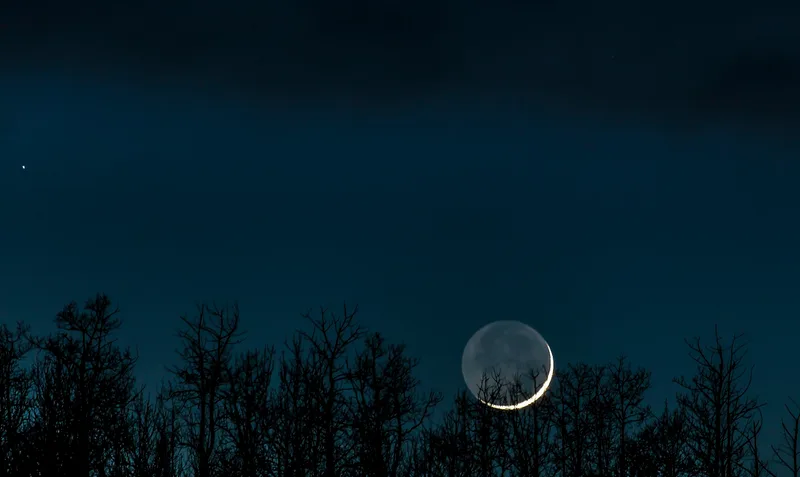
This cycle: 9 November 2026 to 17 November 2026.
Next cycle: 9 December 2026 to 17 December 2026.
Computed 22 November 2026 UTC.
Dates in UTC, for the period between new Moon and first quarter.
Look west just after sunset, in the part of the sky where the Sun went down. A very young crescent follows close behind the Sun and sets soon after it. Later in this phase, the Moon can be much higher at sunset and remain up well into the evening. Over the next few evenings, the crescent widens and generally stays up later. Its height at sunset depends on your location and the season. The first night or two it is so thin it can be hard to find until the sky darkens.
Watch for earthshine: a faint glow on the dark part of the disc, lit by sunlight bouncing off Earth. It is most obvious on a thin crescent in a clear sky.
Just after new Moon, the Moon has moved a little way around its orbit from the Sun's direction, so a thin edge of its sunlit half has come into view. Night by night that edge widens. In idealized northern-hemisphere views the lit edge is on the right; in southern views it is on the left. In the real sky its angle changes with latitude, season and time of night. Near the equator a crescent can look like a tilted bowl; there is no single fixed orientation.
Illumination runs from barely visible up to just under 50 percent. In our birthday calculator a phase angle from 10 to 80 degrees counts as waxing crescent. See how we calculate the phase.
“Crescent” describes the shape. “Waxing” tells you it is growing. A thin crescent and a much wider one can both belong to this phase.
Illustrative illumination levels, not dates or a forecast. Northern-hemisphere schematic views.
Waxing crescent: less than half illuminated.
The 50% endpoint is first quarter. These are idealized views; the angle also changes with latitude and time of night.
After new Moon. Growing toward first quarter. Look in the western sky after sunset.
Before new Moon. Shrinking after last quarter. Look in the eastern sky before sunrise.
Explore the waning crescentTime of day is a better first clue than “left or right.” A photograph can be rotated, and the Moon’s angle in your sky changes. The bright edge faces toward the Sun.
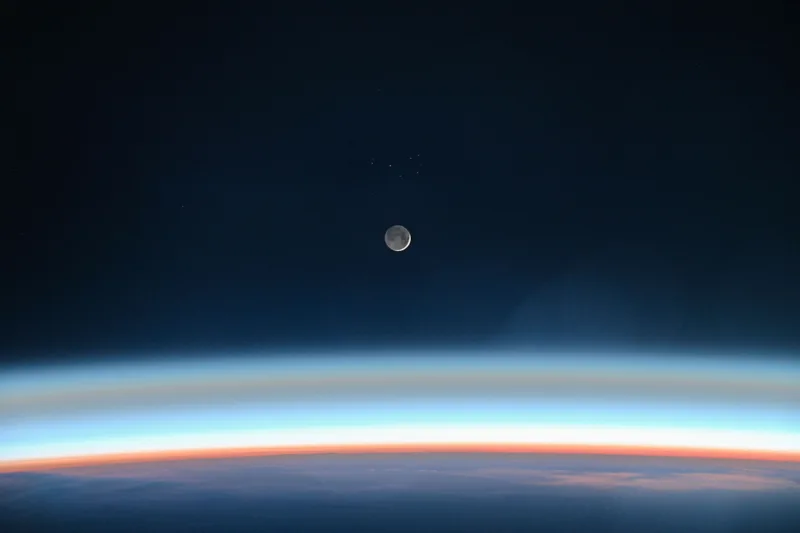
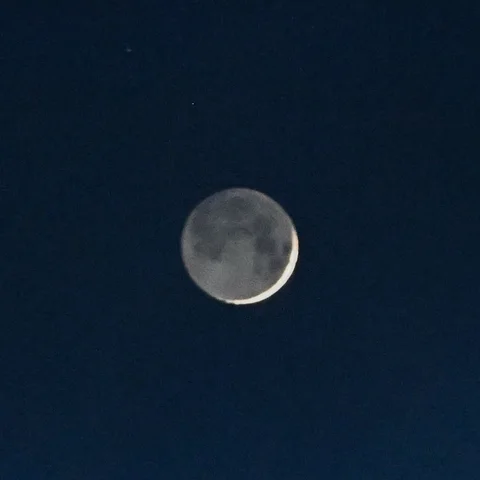
The bright crescent is lit directly by the Sun. The dim rest of the disc is receiving sunlight reflected from Earth.
You may spot this faint glow with your eyes on a clear evening. A camera exposure can make it look much stronger. It does not mean the Moon is nearly full.
Sun → Earth → Moon → your eyes
General observing guidance, not a visibility prediction for your location. Clouds and the horizon matter.
Sources: NASA’s phase guide and the NASA earthshine photograph and explanation.
Was there a crescent like this on the day you were born? Enter your full date below to check, or find your birthday Moon to see its shape and how much was lit. It may have been a very thin sliver or a much wider crescent.
If your result is waxing crescent, our playful name for it is The Brave One: “You keep going while it's still mostly dark.” It is a character we wrote for this site, not a scientific description of people born under this phase.
Use your birth year. The Moon on the same day and month usually has a different phase in a different year.
Were you born under a waxing crescent Moon?
FOR FUN AND REFLECTION
You were born as the first thin light appeared after the new Moon. It's the most fragile moment of the cycle. The crescent is easy to miss, low in the evening sky and gone soon after sunset, yet it's growing every night. That's you: quietly determined, often underestimated, always gaining ground.
Continue to your Moon readingThe Moon's phase at birth has no proven effect on personality.
In astronomy, waxing crescent names a growing shape, not a message about your life. Personal or spiritual meanings are ways people interpret that shape. Our Brave One reading takes the small patch of light as an image for beginning before everything feels certain.
That first step need not be dramatic. It could be sending a message you have been putting off or trying something again after it went badly. What would make a start possible today? You can borrow the question without following a ritual or treating the phase as a prediction.
Compare your birthday Moons to see their lit areas together. You only need both full birthdays. Try a partner, a friend or someone in your family; the shapes do not decide whether you get along.
Our Brave One reading uses the growing crescent as an image of beginnings and first steps. That is a metaphor for reflection, not a scientific prediction or a rule about when to act.
Roughly a week between new Moon and first quarter. The very first part can be too close to the Sun to see; there is no guaranteed number of visible evenings.
A very young Moon is close to the Sun in the sky and can set before twilight is dark enough. Your latitude, season, horizon and weather affect when you first spot it. Try again on the following clear evening.
An evening crescent after sunset is waxing: the bright part is growing. A waning crescent is shrinking and appears before dawn. The time of day is a better clue than which way a photograph has been turned.
CHECK THE ASTRONOMY
NASA’s phase guide explains the changing sunlit shape. Its Moon viewing tips cover earthshine and the crater shadows along the light-dark boundary.
Dates above are calculated with Astronomy Engine. Our calculation notes explain how the birthday categories differ from exact phase instants.
What Moon were you born under?
Find my Moon