Moon phase
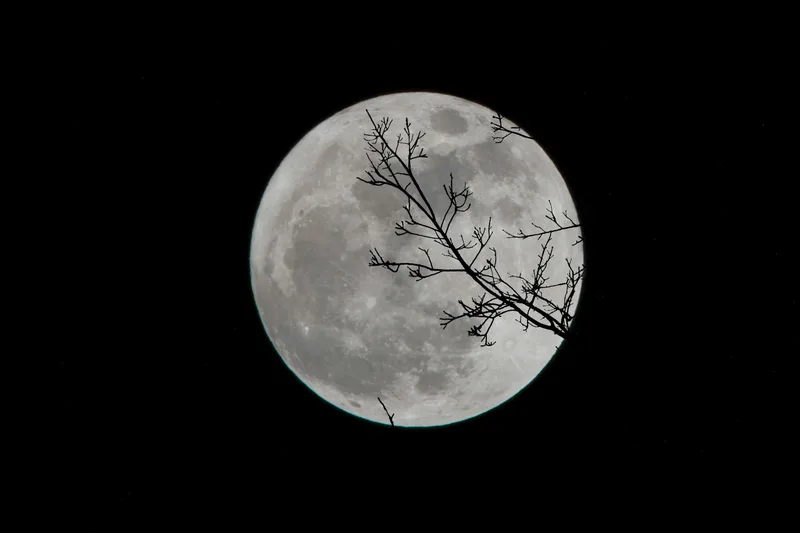
The full Moon
Next full Moon: 24 November 2026 at 14:54 UTC, 24 November 2026 at 09:54 EST US Eastern. Beaver Moon.
The one after: .
Computed 22 November 2026 UTC.
The time above is full phase, not moonrise. Plan when to look where you live.
A full Moon is the phase when the Moon is opposite the Sun in our sky, with its sunlit face turned toward Earth. It rises around sunset and sets around sunrise. The exact full Moon is an instant; to your eyes, the Moon can look full on the nights around it too.
The next 12 full Moons
| Date | UTC | US Eastern | Name |
|---|---|---|---|
| 24 November 2026 | 24 November 2026 at 09:54 EST | Beaver Moon | |
| 24 December 2026 | 23 December 2026 at 20:28 EST | Cold Moon | |
| 22 January 2027 | 22 January 2027 at 07:17 EST | Wolf Moon | |
| 20 February 2027 | 20 February 2027 at 18:24 EST | Snow Moon | |
| 22 March 2027 | 22 March 2027 at 06:44 EDT | Worm Moon | |
| 20 April 2027 | 20 April 2027 at 18:27 EDT | Pink Moon | |
| 20 May 2027 | 20 May 2027 at 06:59 EDT | Flower Moon | |
| 19 June 2027 | 18 June 2027 at 20:45 EDT | Strawberry Moon | |
| 18 July 2027 | 18 July 2027 at 11:45 EDT | Buck Moon | |
| 17 August 2027 | 17 August 2027 at 03:29 EDT | Sturgeon Moon | |
| 15 September 2027 | 15 September 2027 at 19:04 EDT | Corn Moon | |
| 15 October 2027 | 15 October 2027 at 09:47 EDT | Hunter's Moon | |
| 14 November 2027 | 13 November 2027 at 22:26 EST | Beaver Moon |
Computed 22 November 2026 UTC. Full Moon is an instant, so the date can differ by a day depending on your timezone. The Moon looks full for about three nights.
When the full Moon turns red
During a total lunar eclipse, the full Moon can take on a copper-red glow. That is the origin of the nickname Blood Moon.
Full Moon names
These are common North American calendar names, not different kinds of Moon. A Pink Moon is not expected to turn pink, and a Strawberry Moon does not have to look red. The names in the table are labels for the calendar months; naming traditions vary.
- January to March: Wolf Moon, Snow Moon, Worm Moon.
- April to June: Pink Moon, Flower Moon, Strawberry Moon.
- July to September: Buck Moon, Sturgeon Moon, Corn Moon.
- October to December: Hunter's Moon, Beaver Moon, Cold Moon.
Harvest Moon follows a different rule: it is the full Moon nearest the September equinox, which can fall in September or October. The month labels above should not be read as a calculation of the Harvest Moon.
A Blue Moon is another calendar label. A supermoon describes a full Moon near the Moon's closest approach to Earth. Neither is a ninth phase.
What a full Moon actually is
Outside an eclipse, the Sun lights roughly half of the Moon. At full Moon, that half faces us squarely. If the alignment is close enough, the Moon passes through Earth's shadow and there is a lunar eclipse. During totality, when the whole disc is inside the darker shadow, it can look copper red. The duration and shade vary from one eclipse to another. Most months the Moon passes a little above or below the shadow.
In our birthday calculator a phase angle from 170 to 190 degrees counts as full Moon, a band about a day and a half wide. A birthday near the event may fall in our full-Moon band or a neighboring gibbous band. We check the phase at 20:00 UTC on your date rather than treating three whole dates as full Moon.
Try watching it rise
The time at the top of this page is the instant of full phase, not your local moonrise. It can fall in daylight or while the Moon is below your horizon. You do not need to be outside at that exact minute: the Moon looks nearly full on the nights around it.
For a rising-Moon photograph, check moonrise and sunset for your location on the evenings around the full Moon date. Choose an open view toward the eastern horizon. For a relaxed look, choose a clear evening around that date; clouds and your horizon matter more than catching the exact phase time.
A hill, trees or a row of buildings can hide the Moon for a while after the listed moonrise. You do not need binoculars to enjoy the view.
A low Moon can look orange because its light travels through more atmosphere. That colour alone does not make it a Blood Moon, which is a total lunar eclipse. If you want to compare its size near the horizon and later in the night, keep your camera’s zoom the same.
Find moonrise for your city on timeanddate and select your viewing date. For a detailed Sun and Moon report, look up local moonrise and sunset with the US Naval Observatory. Choose your location and viewing date, then set the timezone and daylight saving time option correctly. These local rise/set times are different from the worldwide full-phase instant.
Blue Moon or full Moon?
A Blue Moon is still a full Moon. The extra name describes its place in a calendar month or season, not a different shape.
Born under a full Moon
Was the Moon full on the day you were born? Enter your full date below to check, or find your birthday Moon to see its shape and how much was lit. A Moon that looks full in a photograph may fall in a neighbouring gibbous category when calculated.
If your result is full Moon, our playful name for it is The Illuminator: “You see people clearly and feel everything fully.” It is a character we wrote for this site, not a scientific description of people born under this phase.
Use your birth year. The next full Moon above tells you about the current sky, not the Moon on the date you were born.
Were you born on a full Moon?
FOR FUN AND REFLECTION
Your Illuminator reading
You were born under a whole, bright Moon, the one night of the cycle when the full face is lit and the night is at its most visible. It rises as the sun sets, so the two face each other across the sky. That sense of facing, of seeing and being seen, runs through your life.
Continue to your Moon readingThe Moon's phase at birth has no proven effect on personality.
What traditions say it means
In astronomy, full Moon describes how the sunlit face lines up with our view from Earth. Personal or spiritual meanings are interpretations, not predictions about what the phase will bring.
Our Illuminator reading takes the bright, complete disc as an image for noticing. Perhaps a friend has gone quiet, or something you have been working on is finally clear enough to show. What can you see now that you missed before? Use the question for reflection, without assuming the Moon reveals what someone else is thinking.
Questions people ask
Do our birthday Moons have to make a full Moon?
No. That is the idea behind the TikTok trend, not a rule for relationships. You can put two birthday Moons together to see the shapes overlap, whether they fill the disc or leave a gap.
What time does the full Moon rise?
Around sunset near the full Moon date, with the exact time depending on your location and the date. On surrounding evenings it generally rises earlier before full and later after it. Check a local moonrise time if you are planning a photograph.
How many full Moons are there in a year?
Twelve in most years, thirteen in some. The 29.5-day cycle does not fit neatly into our calendar. See the two definitions of a Blue Moon: one counts full Moons in a month, the other in a season.
Does being born on a full Moon mean anything?
It tells you about the Moon’s phase on your birth date. It does not establish your personality or future. Our Illuminator reading is a site-created interpretation for fun and reflection; the phase calculation is the astronomy.
Why does the full Moon look bigger near the horizon?
That is the Moon illusion. It can look enormous rising behind a building, then surprisingly small in your photo. Scientists have several explanations for the effect, but no single settled answer. Try photographs at moonrise and later that night with the same camera and zoom: the apparent enlargement is not a sudden growth of the Moon.
Can a full Moon be seen during the day?
Rarely, and only briefly near sunrise or sunset, because it is opposite the Sun. See which Moon phases are easier to spot during the day.
CHECK THE ASTRONOMY
NASA’s phase guide explains the changing sunlit shape. Its Moon viewing tips cover earthshine and the crater shadows along the light-dark boundary.
NASA also explains what we know about the Moon illusion, and what remains unresolved.
Dates above are calculated with Astronomy Engine. Our calculation notes explain how the birthday categories differ from exact phase instants.
What Moon were you born under?
Find my Moon