A CHANGE IN APPEARANCE
Blood Moon
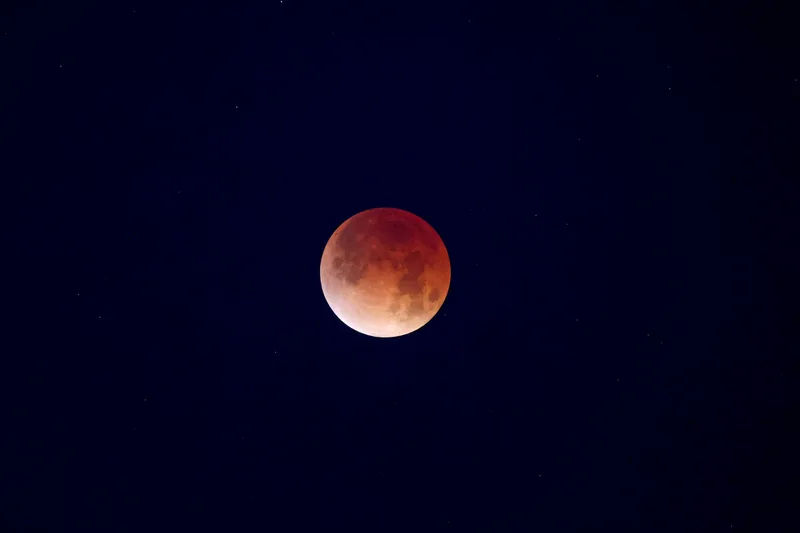
A reddish Moon during a total lunar eclipse. The name describes how it looks.
See how the light gets thereBlood Moon meaning
A Blood Moon is the reddish Moon you see during a total lunar eclipse. Earth blocks direct sunlight from reaching the Moon, but some sunlight passes through our atmosphere and gives it a coppery-red glow.
Why is it called a Blood Moon? The nickname comes from its blood-red appearance. It can look orange, coppery or dark red, rather than bright scarlet. It is still the same full Moon, not a different kind of Moon.
Next total eclipse: December 31, 2028. See times and visibility.
NEXT TOTAL LUNAR ECLIPSE
The next total lunar eclipse happens on New Year’s Eve. In some timezones, it will already be January 1, 2029.
Universal Time, rounded to the minute. Totality lasts about 72 minutes. These are global event times, not a local viewing forecast.
At least part of the eclipse is visible from parts of Europe, Africa, Asia, Australia and the Pacific. Which stages you see depends on whether the Moon has risen or set at your location.
In the US: do not assume it is visible just because it has a date on the calendar. The event is not visible in New York; Honolulu can see at least part of totality. Look up your city on the map before making plans.
Check visibility for my cityNASA’s visibility map and eclipse diagram (PDF)
There are earlier lunar eclipses, but they are not total. A penumbral or partial eclipse is not the same event as this Blood Moon.
Dates and times: NASA’s 2028 eclipse predictions. Local visibility: timeanddate’s observing guide. Checked October 28, 2026.
As of October 28, 2026, the most recent total lunar eclipse was on . The real photograph at the top of this page shows that eclipse over New Orleans.
A later, deep partial eclipse happened on August 27–28, 2026, depending on your timezone. Some publishers called that a Blood Moon too, because much of the Moon turned reddish. It did not become a total eclipse.
That explains why two answers can appear for “the last Blood Moon.” For the last total eclipse, use March 3. For the later event described with the looser nickname, use August 27–28.
NASA lists the March total and August partial eclipses. timeanddate explains its broader use of the nickname. You can also look up the 2026 eclipses in our archive.
The everyday explanation is the color: an eclipsed Moon can look blood-red. “Blood Moon” is a nickname, not a separate astronomical phase or an official eclipse category.
The phrase also has a religious association. The Book of Joel describes the Moon turning to blood. That imagery was used in claims about the four total lunar eclipses of 2014–2015, bringing the name wider attention. Those predictions were religious interpretations, not astronomical findings.
That does not establish who first coined the nickname, or when. Read timeanddate’s account of the name and the 2014–2015 eclipse series.
FOLLOW THE LIGHT
Our planet stops direct sunlight reaching the Moon. Some light still passes through the thin ring of air around Earth and bends into its shadow. More of the blue light scatters away; redder light makes it through.
You are looking at sunlight that has travelled through Earth’s atmosphere before reaching the Moon. The same filtering helps give sunsets their warm colors.
Clouds and dust along that route affect the view. One eclipse can look orange, another deep red or much darker. NASA explains how the atmosphere changes the color.
The Moon does not switch straight from white to red. At first, the outer shadow can produce a faint dimming that is easy to miss. As the Moon enters the darker shadow, a curved dark edge moves across its face.
During totality, the whole disc is inside that darker shadow. It may look coppery, orange or deep red rather than the bright scarlet of a heavily edited photograph. As the Moon leaves the shadow, a bright edge returns and gradually widens.
You can watch a lunar eclipse with your eyes, binoculars or a telescope; eclipse glasses are not needed for looking at the Moon. NASA explains lunar-eclipse viewing. Check the event map first: the Moon must be above your horizon during the stages you want to see.
To connect those stages with the times in a real event, open an eclipse in the archive. The totality duration is only the fully immersed stage, not the whole evening.
PERSONAL MEANING
If you came here wondering whether it means something for you, that is a different question from why it turns red.
You can use the occasion to mark a change, think about something you want to finish, or simply go outside with someone you love. Those are choices, not instructions from the Moon.
We don’t give Blood Moons a fixed spiritual meaning or treat them as predictions. Our Moon-type readings are written for fun, too. Take what fits.
A CHANGE IN APPEARANCE
A reddish Moon during a total lunar eclipse. The name describes how it looks.
See how the light gets thereA PLACE IN THE CALENDAR
The second full Moon in a month, or the third in a season with four. It doesn’t have to look blue.
See both Blue Moon definitionsBoth are full Moons. Neither is an extra phase in the lunar cycle. Explore the full Moon.
Looking for a past event? Search the lunar eclipse archive by year and type.
No. A Moon low on the horizon can look orange or red as its light travels through more of our atmosphere. That alone doesn’t mean an eclipse is happening. Here, Blood Moon means a total lunar eclipse.
The Moon’s orbit is tilted relative to Earth’s orbit around the Sun. Most full Moons pass above or below Earth’s shadow. A lunar eclipse needs the alignment to be close enough.
In a partial lunar eclipse, only part of the Moon enters Earth’s darker shadow. In a total eclipse, the entire disc enters it. Blood Moon usually refers to the total eclipse.
Your phase was full Moon. To check an eclipse connection, you also need the event’s timing and your birth date and timezone. Whether it was visible where you were born is a separate question. Our birthday calculator finds your Moon phase; it does not currently check eclipses.
See the next total eclipse date and visibility guidance above. A global eclipse date does not mean you can see it from home: the Moon must be above your horizon during the stages you want to watch.
See the Moon’s shape and how much was lit on your date of birth, then get a free card to keep or share. No sign-up needed. This checks the phase, not whether an eclipse happened.
Find my birthday MoonThe eclipse geometry follows NASA’s Moon and eclipses guide. The atmosphere explanation is also illustrated in its September 2025 eclipse report. For calendar terminology, see NASA’s Blue Moon definitions.
The opening photograph is by NASA/Michael DeMocker and shows the March 3, 2026 eclipse over New Orleans. It is a documented eclipse, not an AI-generated Moon. Our light-path diagram is an illustration. The personal reflection above is ours.