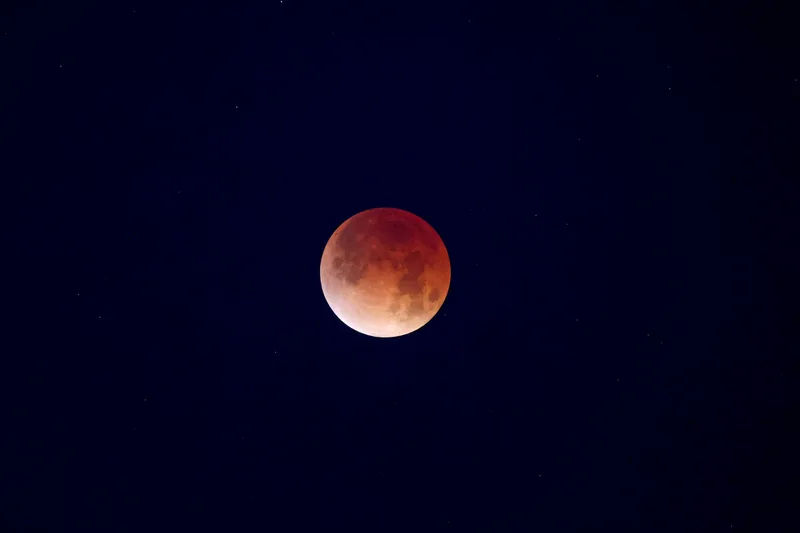
The Moon has crossed Earth’s shadow hundreds of times since 1900. Explore the dates, see which kind of eclipse happened, and find out how long it lasted.
A date tells you when an eclipse happened. The map tells you whether it was part of your sky. Open a result’s NASA map and find your region before deciding which stages you could have watched.
Then convert the times from UT to the local time used there on that date, including daylight saving time where it applied. An event just after midnight UT may have happened on the previous evening in the US. The date printed on a local photograph can therefore differ from the date in this archive.
Finally, check the duration you mean. An eclipse with a short totality can still take hours to cross the outer shadow. The durations in a result overlap; adding them together counts parts of the event more than once.
Was there an eclipse in your birth year?
Start with the year above, then compare the event dates. Sharing a year with an eclipse doesn’t mean it happened on your birthday, during your birth, or above your hometown.
For the Moon’s ordinary phase on your birthday, use our calculator.
Open the NASA map in the result. It shows where the eclipse’s stages were visible. A date in this list means the event happened somewhere on Earth, not everywhere. Your view also depended on the Moon being above the horizon and on the weather.
What does “greatest eclipse” mean?
The moment the Moon passes closest to the axis of Earth’s shadow. It is a reference time, not the start or end of the eclipse. Times here are approximate, rounded to the nearest minute.
Why are there several durations?
The whole eclipse runs from entry into the faint outer shadow to departure from it. The umbral stage measures time in the darker shadow, including totality when present. Totality measures only the time the whole disc is inside that darker shadow. The stages overlap.
Are these all eyewitness records?
No. These are calculated eclipses from NASA’s catalogue. They describe astronomical events, not a list of surviving human observations. This archive starts at 1900; it does not yet cover ancient eclipse records.
The data behind the dates
Eclipse Predictions by Fred Espenak and Jean Meeus (NASA’s GSFC).
Source catalogues: 1900, 1901–2000 and 2001 onward. We show only events whose greatest-eclipse time has passed.
NASA’s source times use Terrestrial Dynamical Time. We subtract the catalogue’s ΔT to obtain UT, then round times and durations to minutes. These are catalogue estimates, not a local observing service. See NASA’s field definitions.
Source snapshot: October 18, 2026. Source calculations extend through 2100; the archive automatically limits results to past events. Photograph used editorially with credit.